
In Massachusetts, transporting a firearm in your vehicle is legal only if you possess the appropriate license and adhere to specific storage and transportation laws.
If you were just pulled over and don’t have an LTC, skip to this section . The next steps matter.
Is It Legal to Carry a Gun in Your Vehicle in Massachusetts?
Yes, you can carry a gun in your car in Massachusetts, but only if you have the proper license and follow strict transport rules.
In Massachusetts, anyone who wants to carry a firearm in a vehicle must have a valid License to Carry (LTC) or Firearms Identification Card (FID), and the gun must be stored securely depending on the type of firearm and license. Worcester residents and others in Central Massachusetts should also be aware that local law enforcement, like the Worcester Police Department, may add specific conditions to your license.
What Are the Requirements for Carrying a Firearm in a Vehicle?
To legally transport a firearm in your vehicle, you must have either a License to Carry (LTC) or a Firearms Identification (FID) card.
Note that an LTC lets you carry handguns and large-capacity firearms, while an FID permits possession of non-large-capacity rifles and shotguns.
According to Massachusetts General Laws Chapter 140, Section 131C, if you’re carrying a loaded firearm under a Class A license, it must be under your direct control while in the vehicle. For Class B licenses, the firearm must be unloaded and stored in a locked trunk or secure container.
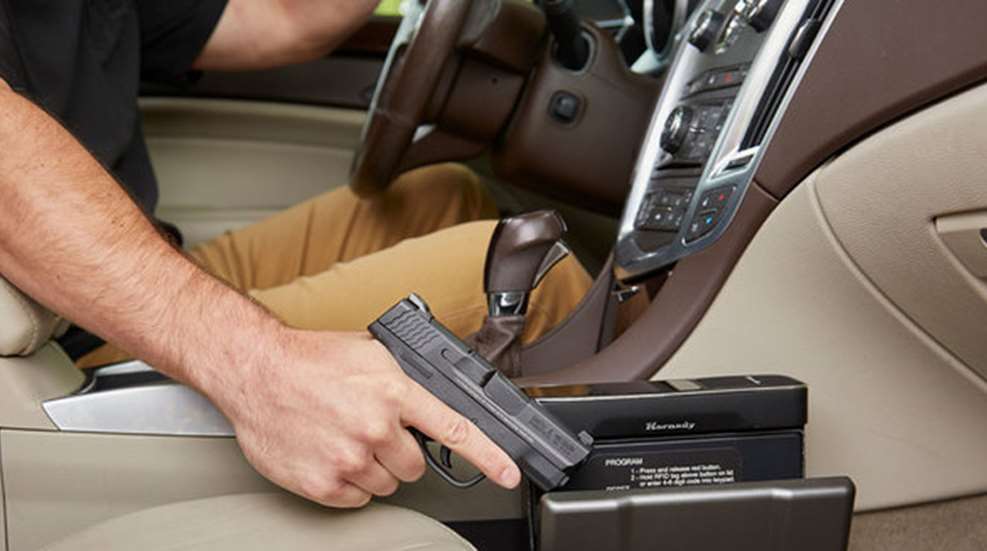
How Should Firearms Be Stored in a Vehicle?
Massachusetts law requires that firearms in vehicles must be unloaded and secured.
Acceptable storage methods include placing the firearm in a locked trunk or a locked case. This applies to all firearms, regardless of whether you have an LTC or FID.
What Are the Penalties for Improper Transportation?
Failing to comply with the state’s firearm transportation laws can lead to serious consequences, like fines ranging from $500 to $5,000, criminal charges, firearm confiscation, and revocation of your firearm license.
What Should You Do During a Traffic Stop While Carrying a Firearm?
If you’re stopped by law enforcement like the Massachusetts State Police while carrying a firearm, especially while driving Worcester County roads, follow the appropriate law enforcement interaction protocol outlined below:
How Can You Ensure Safety During the Stop?
For everyone’s safety:
- Keep your hands visible at all times.
- Avoid sudden movements or reaching for anything without informing the officer.
- Comply with all instructions the officer gives.
These practices help prevent misunderstandings and maintain a safe environment during the stop.
Should You Inform the Officer About the Firearm?
Massachusetts law does not require you to give a firearm in vehicle notification during a traffic stop (no duty to inform). However, even though there’s no Massachusetts disclosure law, voluntarily disclosing this information can show transparency and may make things go more smoothly.
How Should You Respond If Asked About Firearms in the Vehicle?
If questioned about firearms in your vehicle, assert your rights, request your lawyer, and refuse a search if possible:
- You have the right to remain silent under the Fourth Amendment.
- You can politely decline to answer without a lawyer present.
- If the officer asks to search your vehicle, you have the right to refuse unless they have probable cause.
Remember, staying calm and respectful is crucial. If you’re unsure about your rights, ask to speak with a criminal defense attorney.

What Are the Legal Implications of Carrying a Firearm Without Proper Licensing?
Under Massachusetts General Laws, carrying a firearm without the appropriate license is a serious offense. Illegal possession in a vehicle can lead to criminal penalties for unlicensed carry. It’s also important that you understand the appropriate firearm license types, because they affect how and where you can carry your firearm.
What Constitutes Unlawful Possession in a Vehicle?
Under Massachusetts General Laws Chapter 269, Section 10(a), possessing a firearm in a vehicle without a valid LTC or FID is considered unlawful. This offense can be classified as a felony, especially if the firearm is loaded or if you have prior convictions and can lead to an arrest for firearm possession in Worcester.
What Are the Potential Penalties?
Penalties for unlawful possession include:
- Jail time ranging from 18 months to 5 years.
- Fines up to $5,000.
- Revocation of any existing firearm licenses.
- A permanent criminal record, which can affect future employment and rights.
First offenses may mean fewer/lighter penalties. Repeat offenses or possession of large-capacity firearms can lead to harsher penalties.
What if you were caught without an LTC during a traffic stop?
If you were stopped with a gun in your car and you don’t have a Massachusetts License to Carry, you are facing a criminal charge, not a traffic ticket. Under G.L. c. 269, § 10(a), having a firearm in your vehicle without a valid LTC is a crime. It doesn’t matter whether the gun was loaded, lawfully owned, or legal in another state. If it was in your car and under your control, that is enough.
What Sentence Are You Looking At?
A conviction typically carries a mandatory minimum sentence of 18 months in jail if convicted, though the exact outcome depends on the specific charge and how the case is resolved. The maximum in district court is 2½ years. If the case is brought in superior court, the sentence can be longer.
On top of jail time, you are also looking at fines up to $5,000, loss of any firearms license you have, and a permanent criminal record.
What Should You Do Right Now?
Your arraignment will likely happen on the next court day after your arrest. That is a very short window, and what you do in that time matters.
- Do not answer questions from police or investigators beyond giving your name.
- Do not agree to a search of your vehicle.
- Call a criminal defense attorney before your arraignment, not after.
A lawyer can show up at your arraignment, push for reasonable bail, and start building your defense before the prosecution has had time to prepare. Do not discuss your case with anyone else, including on social media, until you have spoken with an attorney.
How Recent Changes in the Law May Affect Your Case
If you have a gun charge that is still open, or if you were convicted after June 2022 and are still in the appeals process, two recent legal changes may work in your favor.
What Did the Guardado Decision Change?
In Commonwealth v. Guardado, 491 Mass. 666 (2023), the Massachusetts Supreme Judicial Court changed who has to prove what in an unlicensed firearm case. Before this decision, you had to prove that you had a license. Now, the prosecution has to prove that you did not. That is a meaningful shift. If the Commonwealth cannot show through proper evidence that you had no license, the charge may not hold up. Whether this applies to your case depends on where things stood when the ruling came down, and that is exactly the kind of question an attorney needs to look at.
What Did the 2024 Gun Law Change?
In July 2024, Massachusetts passed An Act Modernizing Firearms Laws (St. 2024, c. 135). It took effect on October 2, 2024, and it changed several things that matter in criminal cases:
- The old Class A and Class B license categories no longer exist. There is now one LTC. If your charge was filed under the old system, your attorney needs to look at how the change affects the elements of your case.
- Prosecutors no longer need to prove a gun was working. For offenses after October 2, 2024, an inoperable firearm is not a defense to an unlicensed possession charge.
- The rules for out-of-state gun owners changed significantly. A provision that previously allowed non-residents to possess handguns in certain situations was repealed. Massachusetts no longer recognizes any out-of-state carry permits.
If your offense happened before October 2, 2024, the old law governs the facts of your case. But the Guardado ruling on burden of proof applies regardless of when you were charged.These are not questions with simple answers. If you have an open case or are wondering how these changes affect a prior conviction, call our office to speak with Darren Griffis directly.d be avoided until you’ve consulted with your attorney.
Additional Resources and FAQs
Staying informed about Massachusetts firearm laws is essential for responsible gun ownership.
Where Can You Find More Information on Massachusetts Gun Laws?
For detailed information, refer to:
- Massachusetts General Laws Chapter 140, Section 131C: Link
- Mass.gov Firearm Information: Link
- Worcester District Court Information: Link
These resources provide comprehensive guidance on firearm laws and licensing procedures.
Are There Exceptions for Non-Residents?
Yes, non-residents must get a temporary LTC to carry firearms in Massachusetts. This license is issued by the Massachusetts State Police and requires an application process. Federal laws may allow for interstate travel with firearms, but it’s crucial to comply with Massachusetts state laws to avoid legal issues.
Understanding and adhering to Massachusetts firearm laws is vital for your safety and legal protection. Always make sure you’re properly licensed, store and transport firearms according to state regulations, and know your rights during traffic stops. If you face any legal challenges, consult with a qualified attorney to navigate the complexities of firearm laws in Massachusetts.