
Will a legal separation protect my health insurance coverage in Massachusetts?

No “Legal Separation “Button in Massachusetts
This trips up almost everyone who walks into our office. People assume they can file a form, check a box, and be “legally separated.” Massachusetts, unfortunately, does not work this way. Unlike other states, such as New York or New Jersey, there is no legal separation option available. When Worcester County residents come in to discuss legal separation, we have to start by explaining what’s available in Massachusetts.
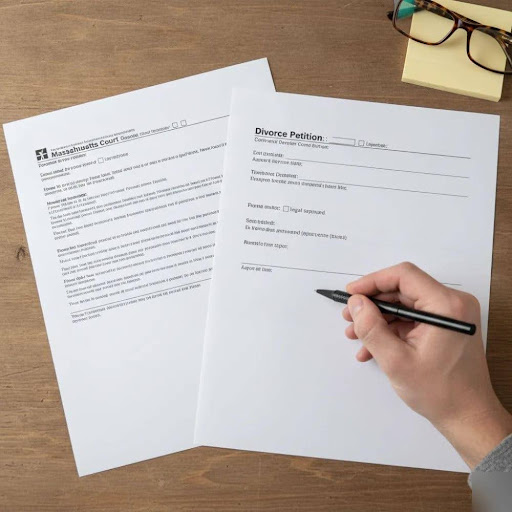
If you’re researching a legal separation filing in Worcester, here’s what you need to know first: Massachusetts doesn’t actually offer “legal separation” as a legal status. What it does offer is something called separate support. You can file for separate support in Probate and Family Court and receive a judgment that addresses issues like custody, property allocation, and financial support. While separate support can serve several purposes, the most important thing to understand is that you remain legally married throughout the process.
Why does this matter for your health insurance?
Get in touch for your free case consultation online or by calling (508) 425-6330.
Separate Support vs. Legal Separation
You might ask, “What is separate support, anyway?” It means you can file an action for separate support in Probate and Family Court to get a judgment in the meantime while you and your spouse are no longer living together. Basically, you’re getting the right to have the judge make rulings about your financial situation and the children’s situation while you’re separated. The Massachusetts Court can use separate support to order the division of expenses, child custody and living arrangements, etc. We often see clients in Worcester County use separate support when the parties are not yet ready to file for a divorce, but they need a separate support judgment to protect themselves and the kids.
A separate support judgment can be used for child custody and parenting time, as well as financial support orders between the parties, use and occupancy of the residence, and division of expenses.
However, it cannot be used to divide retirement accounts, or it cannot be used to split your property permanently, but most importantly, the parties are still legally married. Your marital status still reads as “married” to the IRS, your HR representative, and the health insurance company.
Why does your status matter for your insurance?
Most health care plans in the United States (and definitely your employer’s plan) are based upon the marital status of the employee. You’re typically entitled to keep your spouse on your insurance policy if you remain married. However, once you divorce, your spouse is usually terminated from the plan within 30-60 days, depending on the terms and conditions of the health insurance policy.
The reason separate support can be beneficial for a party is that your insurance carrier likely won’t require your spouse to be removed from your plan (since you remain married), but your spouse will still be covered and eligible for your plan.
We’ve had plenty of cases in Worcester County where one spouse is worried they might lose their healthcare, so they’ve filed for separate support because the spouse they’re separated from has a serious health issue they need to maintain coverage on the other spouse’s plan. It’s common that the party that’s not getting divorced loses their healthcare and the spouse that’s getting divorced doesn’t want to lose the healthcare plan. However, separate support is usually enough for you to live apart and set up the finances and boundaries that you’re worried about without terminating the divorce.
As I mentioned earlier, “usually” does the heavy lifting here. The term “you’re entitled” is not really a valid legal term here because every insurance policy is different. Some employers are beginning to include language in their plans regarding legal or court-ordered separations. You really can’t take anything for granted. Always read your insurance policy. We recommend to our clients that they obtain a copy of the Summary Plan Description from their employer’s benefit’s office prior to initiating anything. It will tell them who is eligible for benefits and how. If you are looking at a legal separation and are worried about your health insurance eligibility, we can explain how filing for legal separation fits into the overall picture of your case. To learn more about how we can help you with legal separation in Worcester, visit our legal separation page. Separate support is not the same thing as simply moving out, so you need to be very careful to file for separate support. Otherwise, there will be no support that can be legally enforced, and no custody order. The court must issue the order. You don’t have it yet.
Contact Us
With over 70 years of combined experience, Rudolf, Smith, Griffis & Ruggieri, LLP can give clients the leadership they need on difficult matters of criminal defense, family law, and more.
How Legal Separation Affects Health Insurance Eligibility
Most people assume that when you move out or file for legal separation, you no longer are eligible for health insurance. It is not automatic. This is also not true in Massachusetts.
A separation only allows you to be on your spouse’s health plan. Your eligibility for health insurance will depend on whether you are still considered married. Since a legal separation doesn’t dissolve your marriage under Massachusetts law, you’re still considered married.
Who Qualifies for Health Insurance?
Most employer-sponsored health insurance plans cover spouses, meaning “spouses” are eligible. So long as you remain legally married, you are still generally eligible for the spouse’s health insurance coverage on their employer’s plan. A filing for legal separation doesn’t legally end your marriage for the purposes of Massachusetts law.
However, each employer has its own health insurance plan. Each plan has its own terms and conditions, and some consider marital status as the sole criteria while others consider if they are living apart or separate their finances. Some Worcester families thought they were covered by a plan until they read more about the fine print and found that the plan had a clause covering “separation”. You want to read your plan, not just the summary.
Get started on your case today; call Rudolf, Smith, Griffis & Ruggieri, LLP at (508) 425-6330 or contact us online to request your complimentary initial consultation.
What May Cause you to Lose Coverage
In most cases, a filing for legal separation doesn’t cause you to lose health insurance, but other circumstances will. The following may cause you to be dropped from coverage:
- Your spouse decides to take you off the plan during open enrollment
- The employer’s plan has a clause for legal separations, and it’s part of the conditions
- You get divorced or the marriage is ended
- Your spouse leaves their job, or changes jobs to a plan that doesn’t provide spousal coverage.
This is another thing most people don’t realize. If your spouse changes to another employer mid-separation, they may be automatically excluded by the plan. You have to be enrolled in it, and you can’t do that without some degree of cooperation from your partner.
Which is why we recommend our Worcester County clients prioritize their health insurance coverage at the beginning of their divorce or legal separation, instead of putting off this important consideration until later.

MassHealth and the Marketplace
If you lose your health insurance coverage while separated, however, you may be able to find other options. In Massachusetts, you have to buy your coverage through a website called the Health Connector, which serves as the state’s health insurance marketplace. If you lose your employer coverage during a separation, it qualifies as a life-changing event. That means that you have access to a special enrollment period that falls outside of the annual open enrollment period.
If your household income permits, you may be eligible to enroll in MassHealth. During a legal separation, your household income will probably change, because you may be living separate from your spouse and paying separate bills. The law only considers your income to qualify you for a health plan.
That means you may gain eligibility for some types of plans that you previously didn’t qualify for. According to the Massachusetts Health Connector, if your annual income is no more than 150% of the poverty line, then you could qualify for MassHealth.
So a legal separation may lead to an increase in the type of health plans you are eligible to participate in.
What We See in Practice
Health insurance comes up within ten minutes in most of our client consultations. It is an important issue. It should be.
We have had clients who have sought a legal separation over divorce because health insurance was their primary concern. In the case of one client, she received regular treatment through UMass Memorial, through her husband’s employer. A divorce would have immediately ended her eligibility, but a legal separation kept her covered during this difficult time.
The point is that you can have choices, if you know what the choices are. If you know what options you have when it comes to health insurance, you may be in a position to negotiate better. But you can’t do that unless you have the right information, about your own circumstances and your own situation, and about the law.
If you are not certain what coverage is available to you, then we may be able to sort that out in a divorce or legal separation case with you.
Legal Separation vs. Divorce: What Changes for Your Coverage
That’s the question that keeps many people up at night. Will a legal separation protect my health insurance coverage in Massachusetts? The short answer is yes, it can. However, the details matter a great deal.
A legal separation and a divorce have very different implications on your marital status, and the implications of your status determines what happens to your health insurance.
The Key Difference
Once a divorce is final, your marital relationship is over. When a judge finalizes the divorce, you are no longer married, legally speaking. And most employers end health insurance coverage at the moment of divorce, because the spouse’s health insurance plan will no longer see your ex-partner as their dependent. They will be treated as a single person who needs coverage on their own.
A legal separation, however, treats you as still being married, even if you are living apart. You and your spouse will probably be legally bound in some way, either by a settlement agreement or a court order, to pay for child support and divide the family property.
The marriage remains intact, which means that one key detail alone can allow you to stay on your spouse’s health insurance. We encounter this situation frequently at our Worcester office. A client may want to get out of a bad marriage, but is dependent on the other spouse’s employer plan for coverage. A legal separation gives them time and space to maneuver out of that.
What Employer Plans Care About
Most employers’ group health plans are governed by federal law ERISA and the plans define the covered dependents that are allowed under them. The verbiage usually says: “spouse”. It does not say “spouse in a marriage that is working,” it does not say, “the spouse that you still live with as your domestic partner,” it just says “spouse”. So, if you are living in the state of Massachusetts under a legal separation status and you are still considered to meet that definition of “spouse,” then your spouse’s plan must keep you enrolled. Your spouse’s plan cannot drop you just because you and they executed a separation agreement with Worcester Probate and Family Court and are living under the terms and conditions of that. That said, there are caveats:
- Some plans may state in the contract that they will stop you if you file a legal separation, so read the fine print in the actual contract that you and your spouse have.
- If your spouse has a self-funded company plan, their rules may not be the same as one that is insured by the employer
- MassHealth and other state-based programs may treat people in a legal separation status differently in regards to whether or not they are eligible to participate in their programs
- If your spouse decides that they just want to take you off the plan, you may be entitled to legal help if they are removing you against the terms of a separation agreement
The average annual premium for family health coverage through an employer was over $23,000 in 2023. Losing this type of coverage can be devastating for a family financially if the timing is not right and you don’t have other options.
What Divorce Triggers
After a divorce judgment is entered into by the court, a “qualifying life event” is deemed to have happened. Once this is the case, you have a COBRA period of 60 days to opt-in to your spouse’s health insurance plan. This means that you can keep the same coverage temporarily, but you pay the full premium yourself. This will be expensive, and few people would be able to maintain it. There is no qualifying life event triggered by filing for legal separation in Worcester. You do not have a time period to enter into a COBRA insurance plan, you just continue to be enrolled in your spouse’s plan as their spouse. This matters if someone is trying to navigate a significant or chronic medical situation that has medical costs that must be taken care of by someone. For example, consider a scenario that we have walked through with couples living in areas in the Grafton Hill neighborhood of Worcester, such as Main South. One spouse may be going through health issues that require ongoing treatments. The other spouse is carrying the health insurance. Once a divorce judgment is entered into, the health insurance ends at that point. With a legal separation, they are able to navigate the issues related to child custody, child support, and living arrangements while still maintaining the health insurance plan. It is not intended as a long-term fix. It is a strategy. If you are in the situation where you are comparing legal separation vs divorce the impact on your health insurance plan, we can help you figure out your options. Please take a look at our legal separation page in the state of Massachusetts to learn more about how that works and how it can keep you protected. Of course, each person’s health insurance coverage will be unique and it is not appropriate that everyone would be treated the same. The decision of legal separation may be the right choice or not, depending on your situation.
Frequently Asked Questions
Does Massachusetts have a legal separation status like other states?
No, Massachusetts does not offer legal separation the way states like New York do. Instead, Worcester courts use something called separate support. This lets you live apart and get court orders on money and living arrangements while staying legally married. That marital status is exactly why your health insurance can often stay in place. Our legal separation page walks through how separate support fits your situation.
Will filing for separate support automatically protect my spouse’s health insurance?
Not automatically, but it often helps. Since you remain legally married under separate support, your spouse usually stays eligible for your employer plan. However, every insurance policy has its own rules. Some Worcester employers now write in language about court-ordered separations. Always check your plan before assuming coverage will continue.
Should I handle separate support paperwork myself or talk to an attorney?
You can technically file separate support paperwork yourself, but mistakes are common. Simply moving out does not create any legal order. Without a court judgment, you have no enforceable custody or support terms. If health insurance coverage is a concern, an attorney can help you request the right documents and file correctly the first time.
How do Worcester employers typically handle spousal health coverage during separation?
Worcester employers, like most across Massachusetts, base spousal health coverage on legal marital status, not living arrangements. Large employers in the area, including hospital systems and manufacturers, usually keep spouses covered as long as you’re still married. Some plans now ask about court-ordered separations specifically. Request your Summary Plan Description from HR to see exactly how your policy defines eligibility.
What document should I request before relying on separate support for insurance?
Ask your employer’s benefits office for the Summary Plan Description before you file anything. This document spells out who qualifies for spousal coverage and under what conditions. Some plans only look at marital status, while others also consider whether you live together. Reading this first can save you from surprises later.
Can separate support turn into a permanent solution, or is it always temporary?
Separate support can last as long as needed, but it doesn’t replace a divorce judgment. It only resolves custody, support, and living arrangements while you remain married. Many Worcester County families use it for years when insurance coverage or other reasons make staying married beneficial. If your situation changes, an attorney can explain how separate support connects to your longer-term options.
Contact Us Today
Get Started With a Consultation.
Hablamos Español.